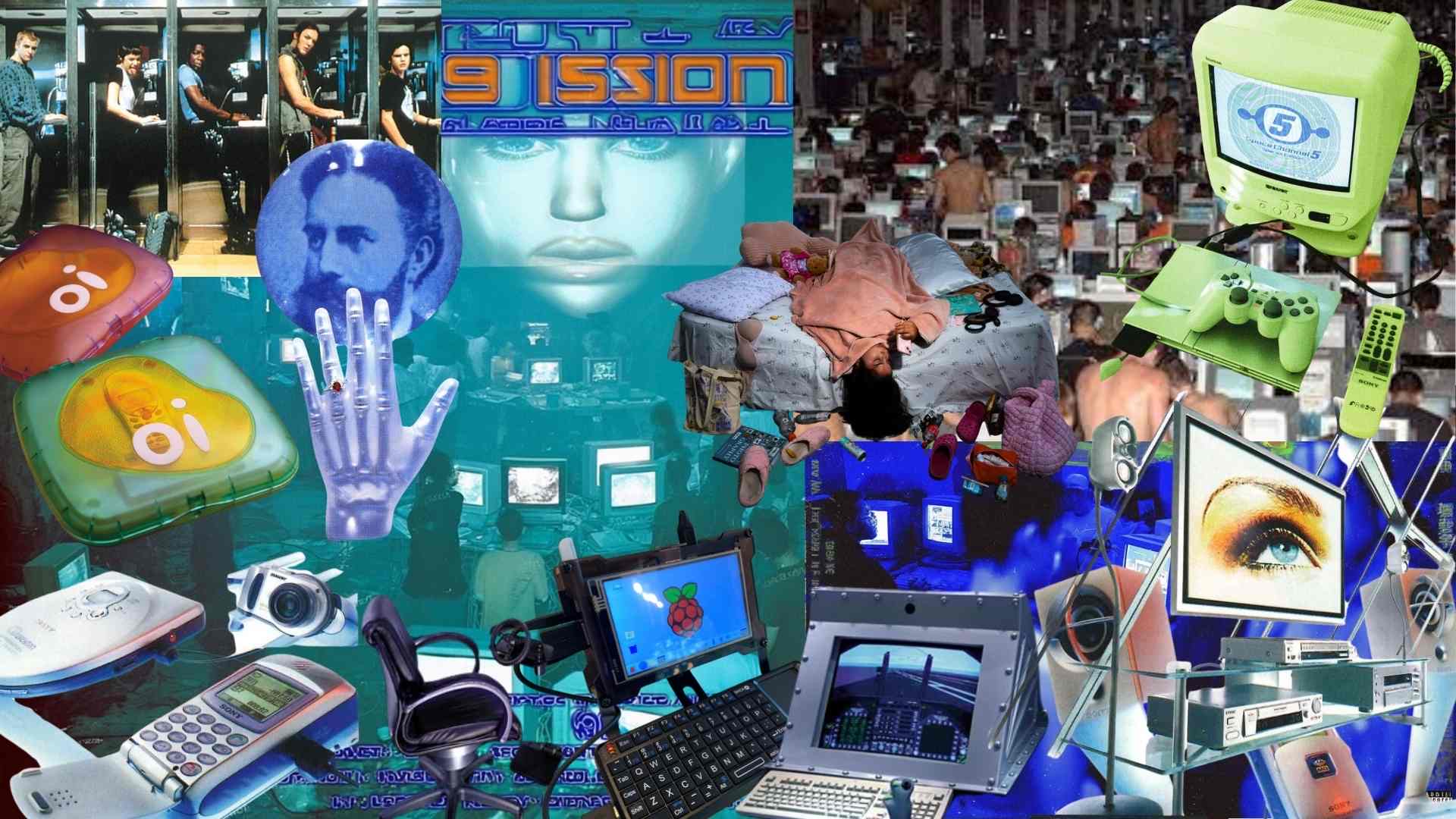
tl;dr: This is the background for the vote to participate in the funding of Dead Internet Theory, the new project by Paizley Lee. Shareholders can review the deal memo here and vote here.
The Game I Lost
The first time I played in one of Paizley’s games, I wildly failed. I did not know what I was doing or how anything worked and I just started a new job and was too distracted to do much more than follow some of the other players on Instagram. But it was clear I was in a well thought “real” place online with real people. I failed my team early, but I was completely mesmerized.
Paizley creates participatory long-form multi-player games. A couple hundred people show up and a story unfolds in a cross between digital and physical space, with the players exploring the system she builds. There is no spectator experience, it’s designed to be played. Either you are in it or you are not in it, and honestly it’s not clear how anyone finds out about it beyond word-of-mouth.
The thing I felt, walking out of that game, was jealousy. A kind of architectural envy. She not only built something I never even imagined, but had a dedicated group of players! I wanted to play again and I wanted to immerse myself and not get distracted by boring things like a “job”, and now there is an opportunity to support making more of this happen.
I have been KmikeyM for eighteen years. I sell shares of myself, and part of that process is shareholders deposit money with me to make trades. The KmikeyM shareholder fund holds all the deposits plus money I put in to cover the costs of servers and various services. This money earns a little interest, but mostly it is doing nothing. It’s a lump that is sized to cover a redemption pressure should it happen. When Marcus sent me Paizley’s deck for her new project, Dead Internet Theory, the jealousy came back, but I was able to sort of judo throw that feeling into a way to participate.
This is the long form explanation of a proposal to back Paizley’s Dead Internet Theory with $5,000 from KmikeyM.
I want to walk through the path that led me from “I want to be near this” to “I think we should put $5,000 of the shareholder funds into it.” This is as much for my clarity as to make a case. This is a new kind of vote about a project, a person, a moment, and a deal.
I had a call with Paizley at the end of April. The inner mechanics of the deal we agreed to are kept private under our New Vote Terms of Engagement policy, but she has agreed to allow shareholders to view the deal memo we agreed on. The vote is simple enough: KmikeyM soft-circles $5,000 as first money in, our return is capped at 2X, and our endorsement helps Paizley close the rest of her raise. But of all the “investments” we could make, I want to talk about why this one…
The Dead Internet Got Real
The phrase “dead internet” used to be a conspiracy theory. It started on a 4chan-adjacent forum in January 2021. The claim was that most of the internet had been replaced by bots and AI-generated content, and that real human conversation online had quietly died sometime around 2016 or 2017. The original post read more like an outraged teen than an argument. It was obviously not true, but it felt true.
And it feels even more true today.
The pivot point was probably November 2022, when ChatGPT shipped, and from there took less than two years for the theory to swing from paranoid to descriptive.
By spring 2024, 404 Media had documented the Shrimp Jesus Facebook ecosystem: AI-generated images, AI-generated comments, AI-generated engagement, all running on top of real human boomers who could not tell. By early 2025, Spotify’s playlists were full of AI ghost artists nobody could name. The conspiracy theorists turned out to have been wrong about the mechanism (it was not happening yet) and right about the destination (it was about to).
I’ve played with this myself. I love the blog that my own bot was writing. Slop? Maybe… but it’s my slop so it feels special.
Anyway, this is the condition Paizley’s project is responding to. The condition is not “AI is bad.” The condition is that the feeling of being online has changed, and that scrolling no longer feels like contact with other humans, and that a generation of people who lived through the transition is now actively looking for places that are not the feed.
Indie web infrastructure has been quietly building back: Kyle Drake’s NeoCities, Are.na, Yesterweb, and I’d even say wiki projects like Stephen Ango’s Obsidian. Small Web September ran for the first time in 2024. The audience for “the internet was a place once” is bigger now than it has been in a decade. This isn’t nostalgia, this is a righting of the wrongs.
The opportunity in front of us is not that we get to build that movement. The movement is already happening. The opportunity is that we get to participate in it, on the right side, at the right moment, with the right person.
Get People in Rooms
Paizley’s project is not the first version of this idea. It is the latest one. There is a lineage:
- XOXO Festival was a very Portland kind of precursor. I was around for a number of these and always liked the idea of a gathering for “people doing creative work on the internet.”
- Webstock in New Zealand, every year since 2006, doing similar work for a different audience. I’ve never been, but I’ve always wanted to!
- Small Web September launched in 2024 as a distributed month-long format: anyone could host an event, anywhere, as long as it was about the internet-as-a-place.
- The Vintage Computer Fair in LA, every year, where Paizley goes to source the equipment for her events.
- And so many more…
Dead Internet Theory sits inside that lineage. The way Paizley described it on our call: she does not want premium activations, she does not want gatekept VIP rooms, she does not want any of the Coachella-grade brand-bullshit that has eaten most of the live event industry. She wants a room you can feel free to “move the couch in.” She wants kids to bring their own home built cyberdecks to show off. She wants people to touch and use the equipment.
What Paizley has that the festivals before her did not have, is timing, taste, and tenacity. Dead Internet Theory is running on the downside of social media. The cultural appetite for being in a room with other humans, doing something real, is bigger than it has been since the Bowling Alone era of the late 1990s.
@kidgrandma
Paizley Lee runs WORKSUCKS™. She publishes online as kidgrandma. She lives in Los Angeles, and on the call she described herself this way: “I have no formal background in tech, I have no formal education in art. It’s all very serendipitous.” I see myself and KmikeyM in that. We did not come from a deep tech and finance background. The first version of the site was Greg’s first time building with Ruby on Rails. I was a “fan” of finance, but not educated about it in any meaningful way. But this is also why it worked, and why I think Dead Internet Theory will work.
What she actually has is more interesting than brand connections or an art degree: Her previous work is about to get some upcoming press (past due in my opinion, but she has worked on these projects in the margins). She has a working relationship with tech artists in LA and NYC. She has a crew unwilling to not make it happen. And she has the aesthetic instincts to know that selling a participatory event to a brand as “premium activation” is the wrong move.
She’s running the first run of the idea at ARC/8 in LA as a proof-of-concept (and it kills me that I’ll be out of town). She’s been doing this kind of work for two years already and now she’s leveling up.
She is also doing her first formal raise. The minimum she is looking to close is $15,000, of which KmikeyM’s $5,000 will be the first. She has been pitching to people in her network already and I know how much having money already soft-circled makes it easier to raise.
The thing that came through hardest when I talked with Paizley was not the deck or the timing. It was the ferocity. She has a way of describing what she wants the room to feel like that does not sound like a creator angling for capital. It sounds like somebody who has already lived inside the experience and is telling you what it was like. The deck is good, but in person her pitch is better than her deck.
Los Angeles, May 17
If the vote passes and the money lands, here is the first thing the money helps make.
A: A Saturday night in May, in an art space called ARC/8 in Los Angeles. Two hundred people. Most of them have brought a laptop, a cyberdeck, an old PSP, a piece of gear they have not had anywhere to show off. The walls are running 90s and 2000s film projections. There is a CD-burning station. There is a station for decorating CD covers. There is a Raspberry Pi station for building mini cyberdecks. The food is internet-café food: orange chicken, mountain dew, Doritos, sour belts.
B: The 22 retro PC stations in the middle of the room are the visual anchor, but they are not the point. People are not lined up to play Counter-Strike. They are lined up because there is also a custom-made mini-game that runs on those PCs, a musician who does not normally make games made a collaborative web-game that lives next to it, and a group of strangers who came in solo are now building a cyberdeck together at the personalization station. The room sorts itself into pockets. People bring gear from their cars. People show up because they heard from friends-of-friends.
C: Afterwards, people take physical objects home: a CD they burned, with a cover they decorated, full of music they made or found in the room. The cyberdeck they built. Maybe a hand-printed zine the artists made in the back room. And then they get to share it. Likely on the slow internet, on Are.na or in a group chat or on a NeoCities page, and the photo of the room will spread, and the next event will sell out faster from a wider friend-of-a-friend network.
Escape from L.A.
LA on May 17 is the proof of concept. Paizley is producing it on a small budget, mostly out of pocket and on a budget of friend favors. LA is the testing ground for what happens next. Which is where the investment comes in.
What our money funds is what comes after.
- Brooklyn. First New York stop. Still intentionally on the smaller scale. But now some new goals: prove the format travels, learn what New York does differently, build the audience.
- NYC. A second New York stop. Focus shifts from “prove it” to “monetize it.” First paid tickets. First sponsor commitments.
- Late Summer. First long-form game. The thing Paizley actually built her career around: a multi-day participatory game in physical space with many players, an unfolding narrative, and an attended ending.
- Beyond. The tour continues…
Each event builds on the last. Each stop improves the format. The long-form is the first big test of whether Dead Internet Theory can be the kind of thing that makes money on its own, without grants, without patronage, without a brand activation deal. If it works, the structure scales. If it doesn’t, we still break even, get to be part of the start of this thing, and know that Paizley won’t quit.
Five Thousand
Here is the part I find most interesting.
If the 2026 events work then what 2027 looks like is materially different. Paizley’s Phase 2 ambition, depending on what she learns and the opportunities, includes a possible permanent fixed-location and looking at licensing into retail. Having the ability to dictate terms to potential sponsors to maintain the integrity. Pushing those deals that from “Doritos sends a case for free” to “Liquid Death cornerstones multiple events.”
The Phase 3 trajectory, if all that works, is even more ambitious. The concept she did not say but the deck implies is a highly regarded studio doing experiential events. That could lead to acquisition interest from agencies, or having relationships with tech art institutions. Regardless of how far it goes, I love that the long term vision is to make some kind of cultural-establishment that is based on the people-in-rooms gatherings around the right kind of technology. Because tech doesn’t have to be terrible and if we look back at early user groups, the open source movement, and fan organized events we can see how it works.
Admittedly the probability of a Phase 3 outcome is low. Being the $5,000 first-money-in we’re not looking for some 100X return. What we expect is that we can help generate a meaningful cultural event for some people and make a little money. I think $5K from us has a kind of asymmetric upside seat where the downside is delayed payback, we breakeven, or take a small loss. The upside is a 2X financial return and a permanent connection to Paizley’s work. That’s materially larger than what the shareholder fund could ever earn sitting in reserve.
The financial structure is built so that KmikeyM benefits if Paizley wins, walks away clean if she does not, and never holds equity in any of the bigger upside machines (the studio, the venue, the IP). The structure is conservative by design.
The Vote
The KmikeyM project has had three or four through-lines that have stayed consistent across eighteen years. The most durable one is that a person you can trust is more interesting than a brand you can transact with. That has been a premise of selling shares in the creative output of a human being, of letting strangers vote on private decisions, of running shareholder gatherings online and off. The premise was always that there is more value in the messy real thing than in some surface-level polish that is just a simulation.
What Dead Internet Theory is doing is making the same kind of bet, but scaled to a bunch of people in a physical space instead of a stock ticker. It’s people in a room with their real things to interact with and other people to meet. Paizley is making something outside of the algorithm, outside of the “premium activation” of a brand, and with no backstage or VIP passes. Investing is a bet that there enough people who have figured out that the algo-feeds are costing them too much and are looking for something else. While KmikeyM fights this by trying to embrace it, Paizley is creating an actual alternative.
The thesis-fit between Dead Internet Theory and KmikeyM is the cleanest I have felt on a non-KmikeyM project in years. It is also a project I will not be in the room for! I am in Kosovo through early June and I cannot help produce the LA event, cannot help load PCs into the venue, and can’t even physically attend. KmikeyM’s capital here is going somewhere I cannot directly experience. But I trust that Paizley will not just pull it off, but that it will be amazing, and it will continue to grow.
The headline ask is $5K plus our endorsement; the inner mechanics are viewable via the deal memo. But the decision is yours.
What Happens Next
If you vote YES, KmikeyM commits the $5K and Paizley can name KmikeyM as first-money-in on Dead Internet Theory. Some shareholders will get free entry to any DIT event (get in touch if you’re in LA and want to attend).
If you vote NO, KmikeyM does not deploy the capital. We can all still support Paizley as attendees, volunteers, supporters but without any financial risk.