
Jamin Warren’s Kill Screen piece on Tottenham Hotspur uses Roger Caillois’s 1958 book Man, Play, and Games to argue that capitalism doesn’t just change sports but devastatingly ends them as “play.”
His argument: the Spurs are one of the wealthiest clubs in the English Premier League, and they might get relegated. The owners built a stadium for Beyoncé concerts, bought players for resale value, charged the highest ticket prices in Europe. They optimized for extraction. The English pyramid, a negative feedback system designed to punish exactly this, is punishing exactly this.
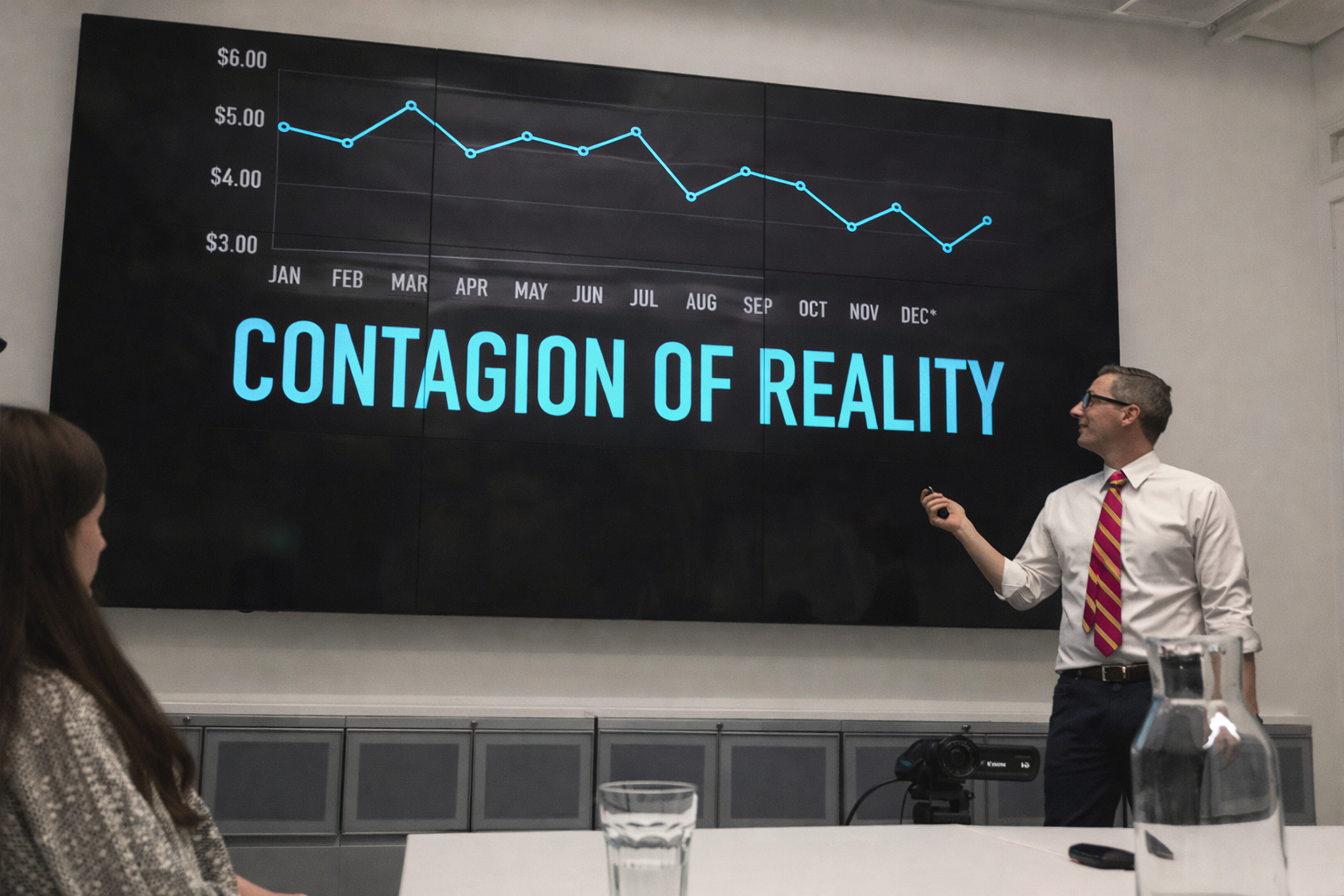
Warren’s frame is Caillois’s “contagion of reality.” Play exists inside a magic circle: bounded, rule-governed, separate from ordinary life. When mundane reality intrudes, like when owners treat a game as an investment vehicle, play doesn’t evolve. It dies. The circle breaks. Warren may be right about Spurs, and right in general about financial interests invading play.

But his conclusion assumes the causality only runs one direction: capitalism invades play and kills it. But what if you built the financial structure inside the “magic circle” from the beginning? Not as an external pressure, but as the rules themselves? What if the IPO, the share classes, the voting mechanics, the dividends weren’t corruptions of play but were the play?
Because I’ve been running that experiment for seventeen years.
Caillois defines play as an activity that is
- free,
- separate,
- uncertain,
- unproductive,
- governed by rules, and
- make-believe.
These aren’t suggestions. They’re load-bearing walls. Remove one and the structure changes. Remove enough and it’s no longer play.
The fourth criterion is the one that seems to kill my counter-argument before it starts. “Unproductive” means that play creates no wealth, no goods. “Property is exchanged, but no goods are produced.” KmikeyM produces profits… Case closed?
Not quite. Caillois’s Chapter IV, “The Corruption of Games,” is more careful than most people cite it. His “contagion of reality” isn’t triggered by the presence of money. Poker involves real money and Caillois treats it as legitimate play, an agôn-alea hybrid where “psychological acumen and character” are the competitive elements.
From Caillois’s framework:
Agôn = competition (skill, effort, merit — chess, sports, fencing)
Alea = chance (luck, destiny, submission to randomness — dice, roulette, lottery)Agôn-alea = games that combine both. The player faces a situation partly determined by chance but responds with skill. Caillois’s prime example is card games where the deal is random (alea), but
how you play the hand is competitive (agôn). He specifically calls out poker as the version where “psychological acumen and character” are the skill elements, versus bridge where it’s knowledge and reasoning.It’s one of his “fundamental relationships. ” The two principles are opposites (self-reliance vs. submission to fate) but they combine naturally because both create equality among players,
just through different mechanisms.

The corruption happens when the game’s isolation breaks. When cheats stop respecting the rules. When professionals stop actually playing. When the bounded world of the game gets contaminated by ordinary life and its inescapable consequences.
The corruption isn’t money. It’s money that stops respecting the circle.
This distinction matters for everything that follows. If Caillois meant “any game involving money isn’t play,” then poker isn’t play, casinos aren’t play, and half of human civilization falls outside his framework. I don’t think he meant that. He meant that when financial incentives override the internal logic of the game, when you optimize for extraction instead of play, the magic circle breaks.
If the corruption isn’t money itself but money that breaks the circle, where does the line fall? Not where you’d expect! There’s a gradient:
- Spurs: financial structure imposed from outside the game. Owners who don’t play, extracting from people who do. The circle breaks. Caillois is right.
- Poker staking: financial structure inside the game culture. A backer puts up the buy-in, the player plays. Staking should corrupt poker by Caillois’s logic because it makes the game “productive,” it introduces investor expectations. But staked poker has existed for decades without killing the game. Players report it often improves play: forces discipline, bankroll management, accountability. The financial structure becomes a mechanic, not an external pressure.
- KmikeyM: financial structure is the game.
We have a data point for that last one. Recently my shareholders agreed to let me stake an AI poker agent in our tournament. The bot finished second and returned 230% ROI. Shareholders voted for it, I funded it, and everyone experienced it as play. Nobody felt a “contagion of reality.” They felt the thrill of a bet they’d chosen to make inside a system they’d chosen to join.
The corruption Caillois warns about isn’t caused by money. It’s caused by money that doesn’t respect the rules. Spurs’ owners broke the rules. Poker staking follows them. KmikeyM is them.
Here’s a provocation: money isn’t real. Not in the way a table is real. It’s a social construct, a shared fiction held up by collective belief. Fiat currency, stock valuations, credit ratings… these are agreements, not objects. Which raises a question for Caillois’s framework: is capitalism itself a magic circle?

Let’s run it against his six criteria…
Capitalism is regulated. Markets have rules, contracts, accounting standards. It’s uncertain. That’s literally what speculation is. And it’s fictive. The entire system runs on shared belief in abstractions. Three for three!
But it fails the other three. Capitalism isn’t free… you can’t opt out. Try telling your landlord you’ve decided to stop playing. It isn’t separate because it doesn’t exist in a space apart from ordinary life. It is ordinary life. And it isn’t unproductive because creating wealth is the entire point.
Capitalism is half a magic circle. Three out of six.
I feel like KmikeyM patches the three holes. It’s free, you have to opt in by buying shares, and you can sell them and walk away (aka “rage quit”). It’s separate because it’s bounded by its own rules, its own voting mechanics, its own share classes. The game doesn’t leak into your rent or your groceries. And it treats financial returns as secondary to the rules. Property is exchanged, but the exchange is the game, not the point.
Six out of six.
This isn’t play that contains capitalism, or capitalism that mimics play. It’s a complete magic circle that uses financial structure as its rule system. The opening question was whether it could run the other way and put capitalism inside play instead of play inside capitalism. It can. But only if the circle closes all the way.
I think there’s something Warren’s argument misses about relegation, and maybe it’s just because I love the idea so much. It’s not just a feedback mechanism, it’s an entire other game. The match is one layer of play. The season is another. The pyramid is a third: promotion, relegation, the whole shifting board of teams rising and falling. Each layer has its own rules, its own uncertainty, its own drama. Nobody watches a relegation battle and calls it a “contagion of reality.” They call it the best (or worst) part of English football!
Game designers understand this instinctively. In XCOM, the squad battles are one game, but managing the ship, recruitment, and resources is a whole other game layered on top. Removing it wouldn’t purify the tactical combat, it would gut it! Football Manager takes this further: millions of people play a game that is entirely the financial meta-game of football. Transfers, budgets, relegation battles. The matches themselves are barely interactive. The management layer IS the play.
Which means ENIC, Spurs’ ownership group, aren’t outsiders corrupting the game from beyond the circle. They’re players inside the relegation game who got distracted. Like someone playing Monopoly who stops paying attention when the pizza arrives… still technically at the table, but optimizing for something outside the game (the choice of pepperoni vs. Hawaiian). The relegation system isn’t punishing corruption from outside. It’s punishing bad play from inside. That’s what good game design does!
KmikeyM is designed more like this. When the pizza arrives, we decide on whether to bring it inside the circle. The financial structure isn’t a distraction from the game but the mechanic that that allows it to expand. New opportunities, new decisions, new stakes don’t break the circle. They can instead become part of it.

Maybe the question we’ve been arguing isn’t the right one. I’ve been trying to say that KmikeyM lives inside Caillois’s magic circle because the financial structure can be play, and that the circle closes all the way. Six out of six.
But honestly? I don’t always know. It’s difficult, even for me, to tell what’s real and what’s performance. Often it’s both. KmikeyM is more than a game to me! I’ve used it for almost 20 years to shape my decisions, my career, my relationships. But to some shareholders it is just a game. And to others it’s something else entirely, more like a club or a community with a leaderboard.
Caillois argued that the circle had a sharp edge. Inside is play. Outside is reality. Corruption is when reality crosses in. But even his sharp edge has a gradient of six. I’ve always found the most fun happens on the line itself, while dipping in and out, never quite sure which side you’re on.
Perhaps that makes me a troll? A spoil-sport? A cheater? I don’t think so.
Caillois warned about the contagion of reality where ordinary life seeping into the magic circle would dissolve the feeling of play. But he didn’t consider the contagion might run the other way? That play could seep into reality…
That I might build a financial structure so thoroughly inside the circle that the circle starts to expand… absorbing careers, relationships, decisions, seventeen years of my life, all without ever breaking?
Maybe that’s not a contagion, but an inoculation. And instead of dissolving the circle, it dissolves the need for one.
You must be logged in to post a comment.