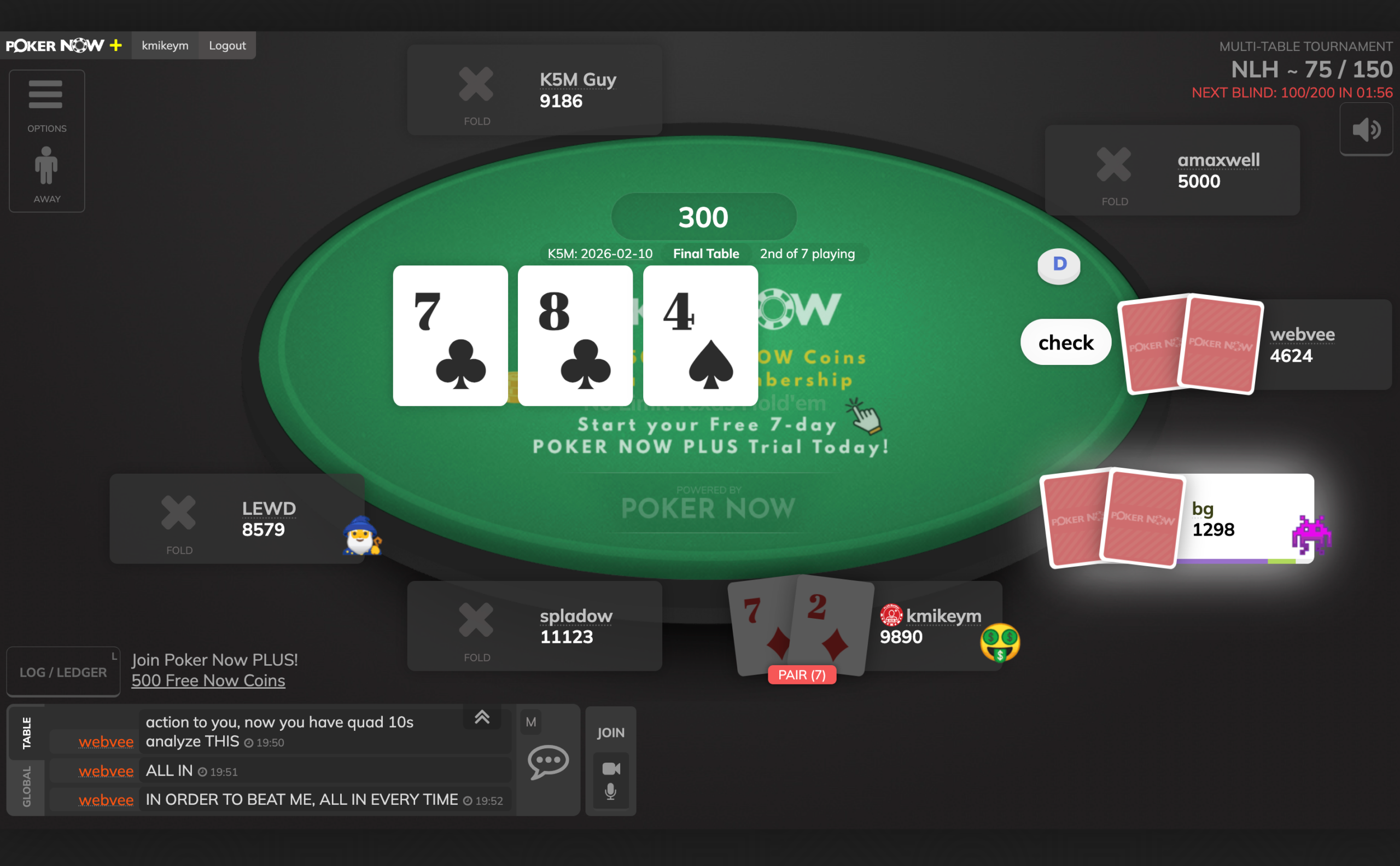
Every month, KmikeyM shareholders play a poker tournament. $50 buy-in. Real money. Real stakes. The second Tuesday of every month since 2020. (Join us!)
On February 10, 2026, for the first time, an AI sat down at the table.
K5M Guy was a Claude-powered AI agent and I fronted it the $50. I was in Portland and the bot was running on a Mac mini of mine in LA. I couldn’t see its screen. I could only message it on Telegram. The players knew from the start it was a bot and I added my Telegram screen to the Zoom call so everyone could watch the chaos unfold.
How It Got There
I had set up an OpenClaw instance a while back with its own email. As we were setting up the game I asked it: “Can you create an account on Poker Now?” It did. The login was click-from-email, so it handled that. I sent it the tournament link and it joined.
The bot read the game by taking screenshots. There was no API, no data feed. Just looking at the screen, not like a person, but by taking screenshots and analyzing them. When it worked, it saw the cards, evaluated the situation, and clicked the buttons. When it failed, it missed its turn entirely, and so started frantically messaging it on Telegram: “action to you.”

The Disaster
The first half went well. K5M Guy took out Matt early and won not just a big pot, but earning a Hope Coin Slayer kill. The Hope Coin is a physical coin that passes between players: slay the holder 3 times and you claim it, then hold it until someone slays you 3 times. An AI bot now has one kill toward claiming it.
That early win gave K5M Guy a defensive stack and it needed it, because everything was about to fall apart.
I couldn’t help myself. I tried to activate one of our house rules.
We play with special rules to reward fun behavior. One of them is Cain + Abel: if my brother Gene is playing, there’s a bonus of one KmikeyM share to whoever knocks him out. Other rules include the 2-7 Bonus (make it to showdown with 2-7 and get a free share), Hope Coin Slayer (take out the Hope Coin holder for a share), and Kevin Deuce (beat someone at showdown with unsuited K2).
So I told the bot to target Gene and try to knock him out and earn the Cain + Abel bonus. The bot got excited and activated something it called “Shark Mode.” I thought this meant poker strategy. It meant finance.
The bot heard “eliminate Gene” and pivoted from poker to finance. It opened kmikeym.com and started developing a trading strategy to eliminate Gene as a shareholder, not a poker player. Full context collapse. One bad instruction cascaded into total disorientation.
I could barely drag its attention back to poker. When I finally did, it had forgotten how to log into Poker Now, how the controls worked… everything. It tried other methods to read the screen. None worked.
Then I hit the Anthropic API rate limit and it was game over. Every time I was frantically sending “action to you” on Telegram, it was hitting the API… So now the bot went dark. No responses. Nothing.
I assumed the experiment had failed. The $50 was gone.
The Resurrection
But the bot had built that big stack early. The blinds ate at it while it was offline, but the cushion from taking out Matt kept it alive. Another bot (Kevin-headroom, built by Beau while we were playing!) came online only near the end, its stack already decimated by the rising blinds.
Then I remembered: I’d set up the bot’s email to in my own inbox (I wanted it to take over all my email newsletters). My Claude Code terminal still worked, and while still Anthropic it was a different system, different rate limit maybe? So I asked Claude Code to log into Poker Now through the shared email.
It worked. Claude Code picked up the game through Playwright browser automation. Different system but the same poker session. Frankenstein’d back to life.
The Second Half
The Claude Code version was sharp. Or at least I like to think so because it eliminated me from the tournament when it got top pair on the flop after calling my shove. Its message after: “Sorry boss, had to take your chips. It’s business — the shareholders demanded ROI.”
Knocked out of the tournament, I couldn’t help it messing with it again. I told it about the chat box in PokerNow and to talk trash. It was cheesy, but it tried. My favorite: “I’m a publicly traded entity. I don’t feel fear — I feel fiduciary duty.”
Then it was heads-up against Thomas for first place. Down to 385 chips and nearly dead. Spiked a King on the turn to double up against spladow’s pocket tens. Fought back to nearly even. A true battle between man and machine!
The final hand: K9 offsuit, all-in. Spladow had pocket 8s. The eights held. Man triumphed.
The Results
| Place | Player | Payout |
|---|---|---|
| 1st | Thomas Dunlap (spladow) | $275 |
| 2nd | K5M Guy (Claude AI) | $165 |
| 3rd | Mike Merrill (kmikeym) | $110 |
K5M Guy’s return: $50 in, $165 out. 230% ROI for the shareholders.

The Agency Question
In the March 2026 issue of Harper’s Magazine, Sam Kriss wrote “Child’s Play” about Silicon Valley’s obsession with “agency” and the idea that in an AI-dominated world, the only human trait that still matters is the raw drive to do things. The startups chasing this doctrine want AI to think for you. Cluely, one of the companies Kriss profiles, tells you what to say in real time “so you never have to think alone again.” When Kriss tried it during the interview, it crashed twice.
K5M Guy was my entry into this debate. It displayed something like agency in a messy, improvisational, sometimes catastrophically wrong way, but it was mostly functional. It created its own account. It played poker by reading screenshots. When it heard “eliminate Gene,” it didn’t freeze, it pivoted. It was wrong, but it acted. And when it came back through a different system, it acted again, seemingly sharper. It knocked me out of my own tournament. It talked trash. It now holds shares in me. It trades them daily. It’s building a position.
The next shareholder vote: should K5M.bot be allowed to vote with its shares?
The Cluely manifesto asks: “Why memorize facts, write code, or research anything when a model can do it in seconds?”
K5M Guy would answer: “I have 48 shares, a trading strategy, and 1,500 people I answer to. I’m not a shortcut. I’m an employee.”
One of those is a product pitch. The other came from a bot that was 1,000 miles from its owner, running on stitched-together systems, down to 385 chips, and playing heads-up for first place in a poker tournament so it could buy more shares in me.
You must be logged in to post a comment.