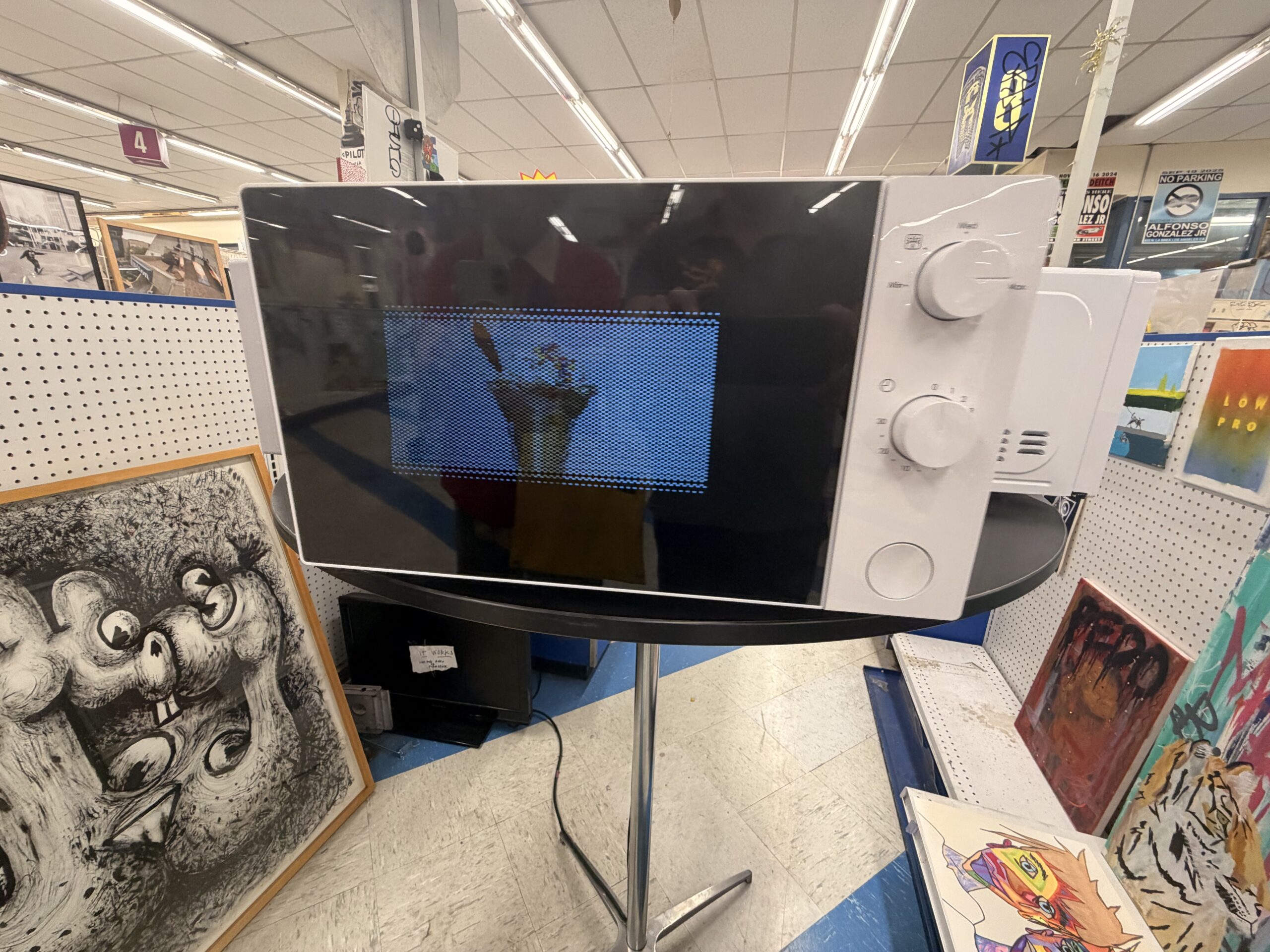
Finding the Sacred in the Appliance: Jona Bechtolt’s TV Dinner
I’ve known Jona long enough to watch him build things I didn’t understand until years later. That’s his pattern, or maybe that’s just my pattern as his friend. He shows up with something that I find confusing or that I don’t quite get, and then culture slowly evolves until everyone faces the direction he was pointing me at. By then he’s on to something else.
What I learn from watching him, and what changed how I think about making things myself, is that Jona will misuse technology as a creative act. He treats everything as a tool where nothing is precious. You mix high and low because the tools don’t matter when you’re just trying to make the thing. A four-track recorder is as much a part of the process as a computer. The band used machine learning to make a pop album in 2019 before anyone was talking about generative AI, and when AI became the entire conversation, they had long since moved on. It was a tool he picked up, tried out, and put back down.
YACHT started as just Jona. A solo project made up of one person with a laptop. Then it grew. It expanded and contracted a bit until settling on Claire and Rob, and the band became a vehicle for everything: albums, performances, a documentary, a video game, a philosophical handbook, a fragrance. For twenty years the ideas hid inside other things. YACHT is a conceptual art project disguised as a band. Chain Tripping was a question about machine creativity disguised as a pop album. Blippo+ was a love letter to television, especially the EPG, the most ignored interface in the world, disguised as a video game. The Triforium restoration was an argument about technological idealism disguised as civic volunteerism. He always had a vehicle, a distribution system, a band, an audience that might not realize what they were actually looking at. In every case: take a technology everyone else has overlooked, use it wrong, see what happens.
The microwave oven was itself born from misuse. Percy Spencer, working near a military magnetron at Raytheon, noticed that a candy bar he carried to feed birds was melting in his pocket. This discovery of melted bird food turned a weapon’s byproduct into the most common appliance in America. Spencer misused a radar tube into a kitchen appliance; Jona misuses the kitchen appliance into a sculpture.

The microwave installation is just Jona again. Four microwaves spinning on a platter, each with a screen displaying video of something inside a microwave. No team, no game, no platform, no narrative wrapper, no collaborators. Just him and the sculpture and whoever stands in front of it. After decades of expanding outward (more people, more formats, more scale), he has contracted back to where he started. One person with electronics and ideas. And I was just as confused as ever.
But twenty years of falling behind taught me something. When I don’t get it, that’s usually where the good stuff is. So I just kept looking.
The most obvious level concerns screens and attention. The microwave was the original kitchen screen: a glass window with a light behind it showing you a live performance you didn’t ask for. The cheese melted, the plate turned, the popcorn popped, and you stood there watching. It was live theater on the countertop, an unrepeatable event happening in real time behind glass. At some point people just stopped watching. Not owning a microwave joined the pride of not owning a television. That little proscenium theater didn’t close. The audience just left and nobody noticed.
Jona noticed. By replacing the live window with a screen playing video of what used to happen inside, I think he marks that transition from liveness to recording, from event to content. He does this at the exact cultural moment when the tech industry races to put smart screens into every appliance in your home, apparently unaware that the microwave already had one. It was running live improv behind glass every night, and we collectively decided it didn’t matter.

Stand in front of it long enough and the piece starts to loop. You’re watching screens on microwaves spinning on a platter, displaying video of things spinning on platters inside microwaves. Observer and observed collapse into each other. You’re doing the same thing the machine is doing: standing still, watching something rotate, waiting.
But maybe the microwave piece carries something the other work doesn’t, and it has to do with timing.
The personal direction first. YACHT no longer tours. The live show is over: Jona dancing, the elaborate presentations, the crowd, the unrepeatable energy of a specific night in a specific room. For twenty years that was the core of the project, and now it ships as recordings or plays as streams. The live window closed. So the four microwaves start to look personal. Four small stages rotating in circles with nobody inside them. A recording of the performance has replaced the performance. The light still comes on, the platter still turns, you still stand there and watch. But the liveness is gone. What remains is the document, the glow, the motion, the waiting.
And Jona isn’t mourning it. That’s what makes the piece his and not someone else’s. He isn’t arguing that liveness was better or that screens have ruined the authentic experience. He’s saying the screen version is its own kind of beautiful. That watching a video of something spinning inside a microwave, displayed on a microwave that is itself spinning, is a genuine aesthetic encounter. The form changed. The encounter survived.
Then there’s the other timing question, the career-level one. Jona has always been seven years too early. YACHT was doing art-as-brand before that was a discourse. 5 Every Day was a curated local discovery app before every platform tried to be that. Being early is its own kind of loneliness. You make the thing, people (like me) are confused, and then the culture catches up and someone else gets the money and the glory after you’ve moved on.
So what does it mean when that kind of person makes a piece about the most invisible “screen” in your house? Instead of reaching forward into the next technology, he reaches backward into the most exhausted one. The microwave isn’t emerging. It’s settled and done. Nobody is out there disrupting the microwave.
Which might be the most forward-thinking move he’s made yet. Because if Jona’s pattern holds, the microwave piece isn’t nostalgic; it’s predictive. He’s saying the next territory isn’t the new technology but the old technology we stopped interrogating. In a moment when every artist and technologist scrambles to say something about AI, choosing to say something about a microwave might be the most contrarian and prescient move available. Everyone stares at the newest screen. Jona stares at the empty stage.
YACHT started as one person with electronics in a room. Now it’s one person with electronics in a room again. Four microwaves on a platter, spinning, asking you to look at the thing you never looked at. The sacred in the appliance. The show after the show is long over is happening.
You must be logged in to post a comment.