Why 2008 Was the Perfect Year to Launch KmikeyM
I don’t remember where I was on September 15, 2008. My notebook skips the whole month. But I can tell you exactly what my shareholders voted on that September, because we did it in public and it is still sitting there.
I don’t remember where I was on Monday, September 15, 2008.
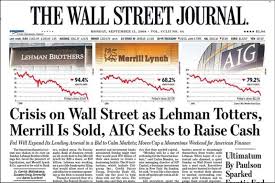
As a publicly traded person I think of it as one of the dark days of finance. It’s when Lehman Brothers filed chapter 11 bankruptcy with $613 billion in debts. The DOW fell about 4.4%, the worst day since markets reopened after 9/11.
KmikeyM.com, my market for shares of myself, launched earlier that same year. I was modeling my life on the financial system just as it was crumbling. Lehman Brothers was a one hundred and fifty-eight year old company… I was less than a year into being publicly traded.
While I’m not sure what I was doing on the day, my notes from that time frame show I was meeting with a group of tech artists in Portland at Maker Lab, designing a strategy/sim game with my friend Erik, and not really paying attention to the actual world of finance.
I had posted a vote in September of 2008 to create the K5M Film Council, seeing if shareholder control of what movies I watched would impact my output. Another vote from this time was ‘Is It Good Review,’ a review website that eventually transformed into 3 Minute Review (which pivoted again into a relationship podcast). But the week the financial system crashed was an otherwise normal week for my little system.
Eight months before the Lehman collapse I had gone public. Early in 2008 was a time for a number of financial services companies to IPO. RiskMetrics Group spun out of JP Morgan, Visa went public a little while later, but the financial reckoning of the collapse of the housing market killed any appetite for most of the year. Only 59 companies went public in 2008, compared to 264 the year before.
My big day was January 26, 2008. I had one hundred thousand shares and started selling them at a dollar each. My thought, as I was fully employed, was to price my nights and weekends, and while technically this was the initial offering, it was not at all a traditional IPO. Twelve friends bought 929 shares in the first ten days (at an average of $1.62). This suited me just fine. I was integrating this new structure into my life and not trying to cash out or raise a bunch of operating funds.
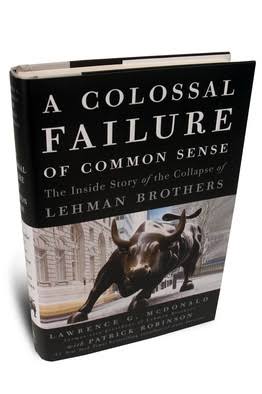
Lawrence McDonald’s “A Colossal Failure of Common Sense“, which he wrote in 2009 about the firm he had just watched die, argues that the collapse was not unforeseeable, but ignored. He ran distressed debt at Lehman Brothers, and says that leadership considered any warnings as a sign of disloyalty.
When the company got into subprime debt it was at more than thirty dollars of assets for every dollar of equity. This amount of leverage worked out great as long as the price went up, but a drop of just a few percent was enough to end it. And what came was not a drop of just a few percent.
From McDonald’s view Lehman failed on three things.
- a) Disclosure – the numbers told the story only after the fact, no one dared share them before
- b) Governance – dissent moved down the building instead of up, leadership refused to allow nay-saying
- c) Leverage – at thirty-one to one this means a three percent move down ends you…
McDonald’s book came out in July of 2009, and it doesn’t even have the worst of it… The worst of it arrived in March of 2010, when the court-appointed bankruptcy examiner published 2,200 pages and a phrase nobody outside the firm had ever heard: “Repo 105.”
Lehman had been moving assets off its balance sheet right at the end of each quarter. About $39 billion at the end of 2007, $49 billion at the end of the first quarter of 2008, $50 billion at the end of the second. It held them off the books for seven to ten days and bought them back once the new quarter had started.
It was a calendar trick. And it worked because in the regulated markets there is only one day you have to look good on. It took a court order and a year and a half to find it, which means the man who worked on the trading floor and wrote a book about why the firm died did not know how right he was about the lack of disclosures…
I tried to write a book. In 2014 an agent came to me unprompted after the Atlantic piece, and my friend Thomas and I put together a proposal called “Secrets of a Publicly Traded Person.” Nothing came of that, but in 2022 I tried again. Kevin Lincoln and I put together a second proposal and actually got an agent. Publishers passed, but we did make the rounds to production companies in Hollywood. Nothing ended up coming from that either, and while I don’t know the reasons for people passing, I do have a theory. Any book about KmikeyM would suffer the same problem as McDonald’s Lehman book, which is that we don’t have the full story yet.
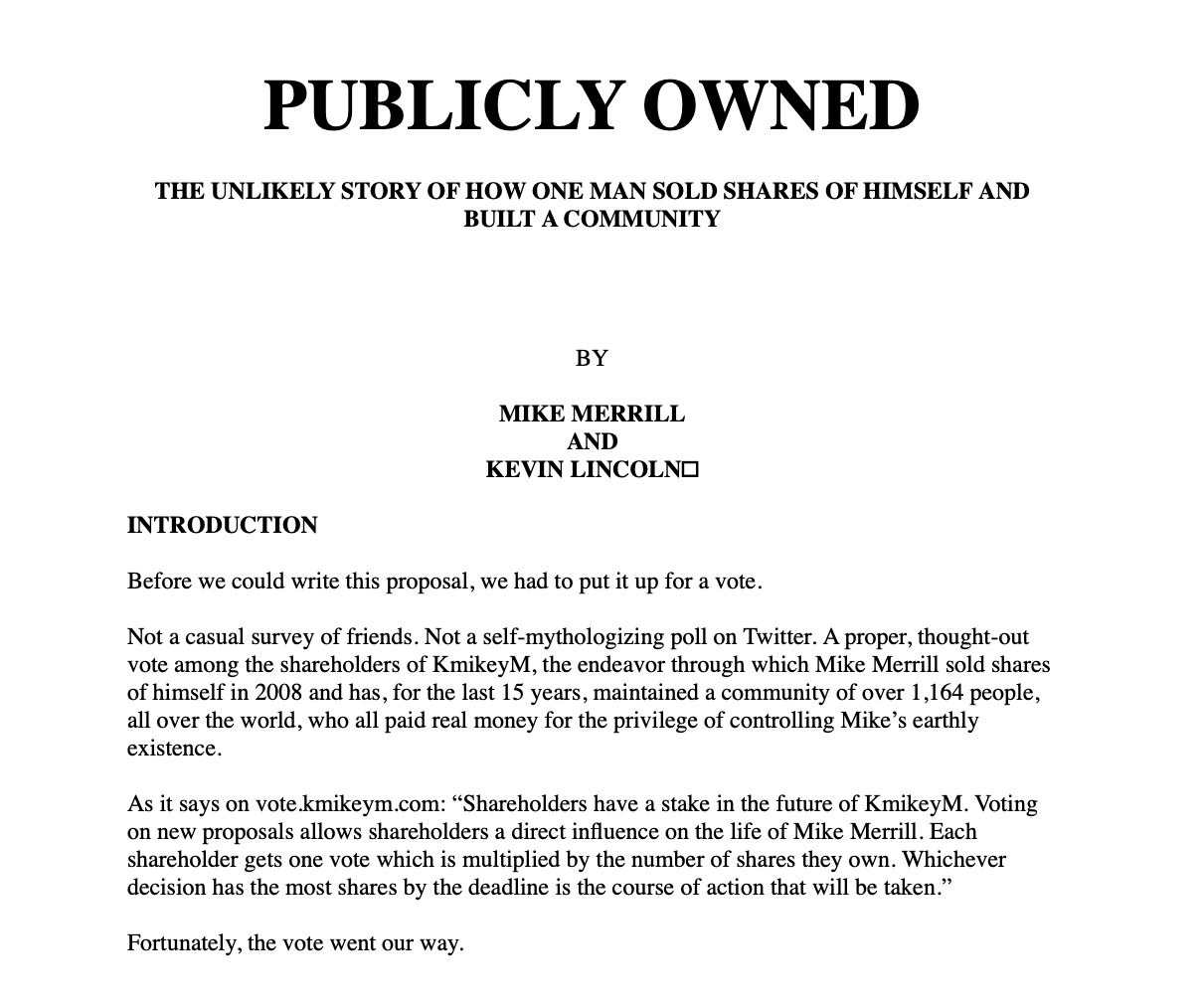
I was mildly embarrassed about it not selling for a while. I was so sure it was going to happen I was planning my own indie book tour. I am less embarrassed now, and still hopeful a book will happen, but I’m not in a rush. A book
is a periodic disclosure. It is the ultimate end of the fiscal year… You pick a date, freeze the story, write it all up, and hope the story doesn’t continue on without you. If either of those books had happened, it would already be missing a lot. The story of KmikeyM is still going, which is the problem with a book (maybe I could pitch it as a trilogy?).
Back to the Lehman Brothers collapse… I look at the failures they had around disclosure, governance, and leverage and think about KmikeyM and how what we built is kind of the inverse of all three. Not because we were brilliant financial designers, but largely because we had no other option (and were learning as we went).
My decisions get voted on and discussed in public, which is a kind of disclosure that happens before the fact instead of after. There is no quarter end or annual report moment to dress up for because it’s all happening in real time.
Dissent is built into this structure. I know it’s a good vote when the discussion ramps up, and rarely does any decision resolve to 100% in either direction. This governance model is a big part of why people trade (more votes is more power). And currently there is no leverage (hmmmmm…), because we didn’t build any way to do that into the market.
As dark as 2008 ended up being for the public markets, it was maybe the perfect year to launch an indie version. It highlighted the counter-example of too big to fail as a market with a single entity that was too small to even notice. In the year when the market was falling and it was impossible to say what anything was worth, I put a value on myself and with the help of some friends and strangers we figured it out.
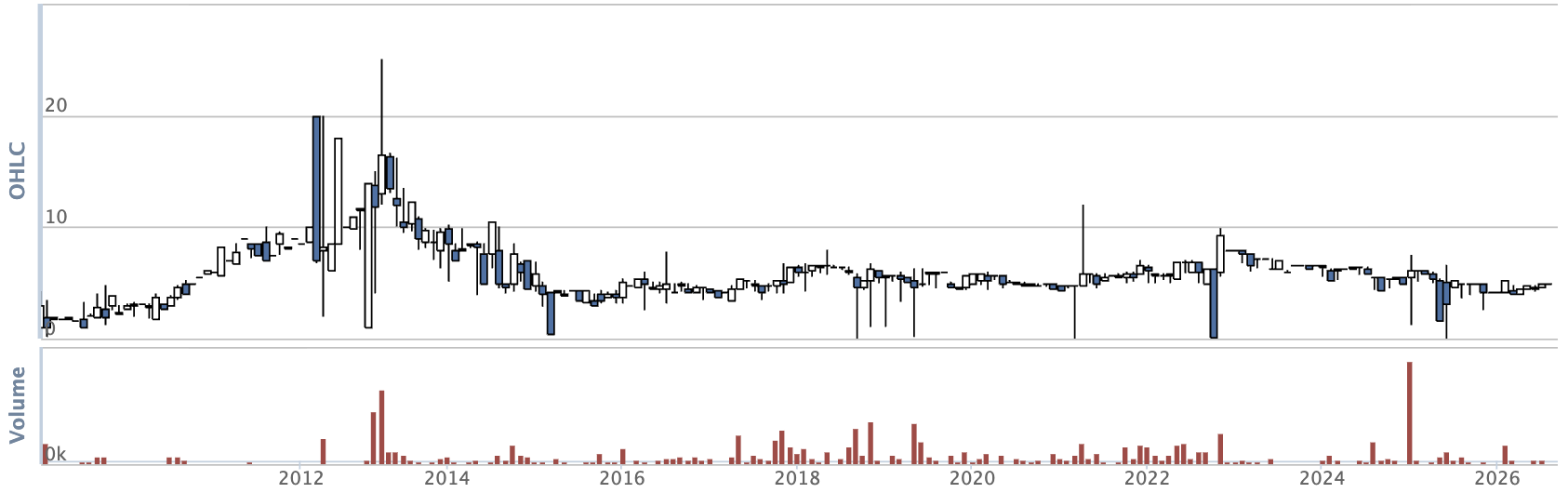
Eighteen years later the price has held at about $5.00 per share ($4.98 as I’m writing this now) for a while and there are 1,245 shareholders holding a traded float of about 24,810 shares. This is far from the high in 2009, the year after the crash, when the initial press landed and got on Hacker News and a software engineering director in San Francisco bought $6,400 of shares. He ran the price up to $11.75 and became my first whale. It was exhilarating and terrifying. Later, with some even bigger press, and my ability to sell constrained by shareholder mandate, the price popped to $20 a share as a rush of new shareholders came in.
Lehman is a case study now, assigned to college students who were in grade school when it happened. My market hasn’t made the jump to Harvard Business School yet, but it is still open. And it’s still relatively small, and still unleveraged, and definitely still unlikely that should things turn south, anyone will show up to bail us out. I guess I have that in common with Lehman Brothers.
I’ve always said that if this project ends, it should end the way a publicly traded
company ends. Looking at how Lehman Brothers ended, and McDonald’s assessment of why, we have at least avoided that particular ending.
Here is a part I did not know until I went looking. Lehman’s shareholders were never asked! The end was worked out over a weekend in a room at the New York Fed, by the Treasury Secretary, the head of the New York Fed, the Fed chairman, and a handful of bank CEOs. Barclays was willing to take it! What killed that rescue was a required shareholder vote the British regulators would not waive. So the last governance act available to a one hundred and fifty-eight year old company was a shareholder vote, and it was the one thing it could not get. They filed for bankruptcy overnight, before the market opened, and the people who owned it got essentially nothing.
That is the ending I think I have avoided. Not the bankruptcy, that could still happen, but an ending nobody voted on.
I can’t promise how this goes… But a vote should definitely be part of the ending, whatever the ending turns out to be: bought, wound down, taken private, hostile takeover, inherited by someone else, or .
Everything here already works with voting, so I hope this mechanism is essential in anything as dramatic as the ending. It would be strange to spend eighteen years putting hair color and film councils and job offers to a vote and then decide the last question by myself…
Although the ending I should probably worry about is not the dramatic finish. Lehman died fast and loud and at scale with the entire world watching. The death available to me is the other one: no trades, no votes, the site still up, nobody around to notice. “Not with a bang but a whimper.” Too small to bail out cuts both ways. The only thing standing between this project and the quiet version is the 1,245 people continuing to show up. For the sake of the eventual book, I aspire to a more dramatic ending.
Note: I am desperate to see The Lehman Trilogy, a three hour play that follows the founding of the firm to the collapse. It’s playing in Ventura, California around my birthday next year.